
Hoornbeek Practical Disputation on Sin, Part 2.
But he was pierced for our transgressions; he was crushed for our iniquities; upon him was the chastisement that brought us peace, and with his wounds we are healed.

President: Johannes Hoornbeek
Respondent: Ubbo Ubbenius
Printed By: Johannes Elsevirius
Translator: Claude 3 Sonnet
Editor: Onku
Manuscript: Here
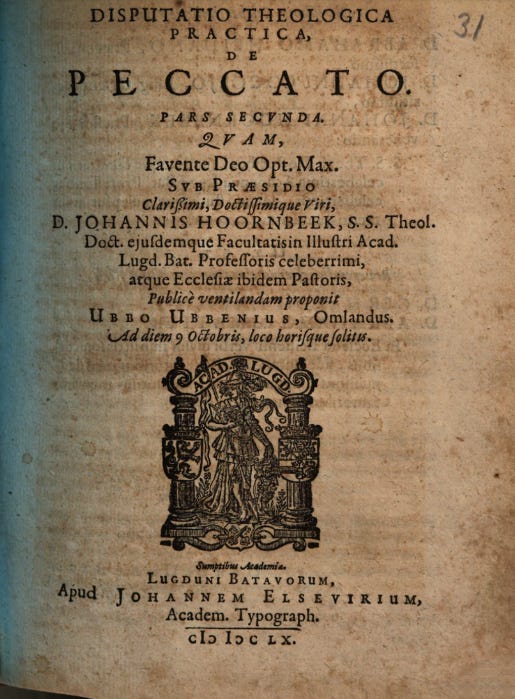
PRACTICAL THEOLOGICAL DISPUTATION
ON
SIN.
SECOND PART.
WHICH,
With the favor of God Almighty
UNDER THE PRESIDENCY
Of the most illustrious and learned man,
D. JOHANNES HOORNBEEK, Doctor of Sacred Theology
and Professor of the same Faculty in the Illustrious Academy
of Leiden, and Pastor of the Church there,
Is proposed for public discussion
by UBBO UBBENIUS, from Omland.
On the 9th day of October, at the usual place and times.
At the expense of the Academy.
LEIDEN,
By JOHANNES ELSEVIER,
Academy Typographer.
1660.
To the most illustrious and celebrated men,
D. ABRAHAM HEIDANUS, most eloquent preacher,
D. JOHANNES COCCEIUS, most skilled in Oriental languages,
D. JOHANNES HOORNBEEK, his venerable president:
Doctors of Sacred Theology, and most celebrated Professors of the same faculty in
the most celebrated Academy of Leiden, who have deserved much from me and my studies,
and continue to deserve daily:
AS WELL AS
To the Reverend and most eminent in erudition men,
D. GERHARD HAVITIUS,
D. ABRAHAM de MATTER,
Most skillful and faithful ministers of the divine word in the Leiden Church,
my most vigorous and vigilant teachers, greatest supporters of my studies:
I offer and dedicate these theses as a sign of due respect and gratitude
UBBO UBBENIUS
Respondent.
PRACTICAL THEOLOGICAL DISPUTATION
ON
SIN.
SECOND PART.
THESIS I
But the positive evils of sin must be assessed from the privative ones which we have mentioned, and their opposition; namely, that not only is the sinner deprived of God's favor, but also feels His wrath, and the effects of an angry God upon the mind. For these things are distinguished, just as among good things the greatest and foremost is to experience God's grace and favor, so among evils, to be deprived of that is most grievous among privative evils; and further to struggle against and be weighed down by His wrath. Psalm 76:8 "You, you are to be feared: and who may stand in your sight when once you are angry?" Nahum 1:6 "Who can stand before his indignation? and who can abide in the fierceness of his anger?"
II
Instead of a peaceful and joyful conscience, to be tormented by its continual torments and stings. Proverbs 18:14 "A wounded spirit who can bear?" This is the worm that gnaws perpetually at the soul, and is itself not extinguished, nor extinguishes the man. Isaiah 66:24
III
Among the punishments of sin must also be counted the other sins into which one falls through prior ones: and thus sins, which is most sad indeed, are the punishments of sins, whereby the misery of man is terribly aggravated and perpetuated. Romans 1:24 "Therefore God gave them up in the lusts of their hearts to impurity."
IV
Then follow bodily afflictions of every kind, the evils of this life: diseases, misfortunes, and remaining calamities. See Leviticus 26. John 5:14 "Sin no more, lest a worse thing come upon you." And these are punishments, either common and ordinary, Genesis 3:16-17, or singular and extraordinary. Moses calls the former "common visitations of men"; the latter occur when God creates something new: as when the earth opens its mouth and swallows up Korah with his company, Numbers 16:29-32, or when the sky rains down sulfur and fire on the Sodomites, Genesis 19:24, to say nothing of the deluge of the first world, 2 Peter 2:5-6, and other similar judgments that God sometimes renders for the singular wickedness of men.
V
Moreover, sin covers the sinner with shame and disgrace before men and angels. Romans 6:21 "What fruit had you then in those things of which you are now ashamed?" Sin is rightly called by philosophers "a shameful evil."
VI
The ultimate punishment of the sinful man is hell, hellfire and infernal torments, lasting and burning eternally in their own way both body and soul
VII
We never sufficiently ponder or describe how great an evil sin is. Therefore, let us also observe this:
1. That sin makes hell, and is therefore more grievous than hell itself. For the reason and cause by which something is such, that thing itself is more such. Unless sin existed, there would be no hell, no man deserving of hell. Chrysostom, Homily 5 on the Epistle to the Romans: "If we loved Christ as we certainly ought to love Him, we would truly judge the offense against the Beloved to be more grievous than hell itself." And Augustine, Epistle 144 to Anastasius: "For he who fears hell, fears not to sin but to burn. But he fears to sin, who hates sin itself as he hates hell." Absolutely speaking, any single sin is more grievous than any punishment. This is evident from the fact that
1. Sin deserves and, as it were, generates punishment. James 1:15: "Then when lust has conceived, it gives birth to sin, and sin when it is full-grown brings forth death." Now that which is the cause of another evil is worse than it.
2. Punishment is not simply evil, but only evil in a certain respect; rather it should be called good than evil. For our sake alone it is evil, insofar as it turns us away from sin: but sin is simply, absolutely, and in every respect always evil. It conflicts with honesty, which is foremost in the order of good things; punishment only with pleasure, or usefulness and advantage.
3. God is in no way the author of sin, but He certainly is of punishment.
4. Finally, punishment only affects and harms man and some particular good of his; but sin affects the infinite God and His supreme majesty.
VIII
See further from this how great an evil sin is, since it is sin itself that makes devils, and deforms the most excellent creatures to such a degree that they become the lowest of all, changing a celestial angel into a demon. The devil himself ought not to seem so detestable and abhorrent to all, as sin which makes the devil, and induces such a change in things and creatures of the highest excellence.
IX
Add thirdly the example of Adam and the first sin, which infected and perverted not just those men, but the entire human race as long as it endures, and rendered it guilty before the supreme Judge; it introduced a grievous catalog of punishments and every evil; finally, it brought vanity and corruption into all creatures and the whole universe. In this first example of sin among men, God willed that we learn both its power and its contagion and duration.
X
Lastly, in Christ and His most bitter sufferings for sin which He endured, God willed to show what and how much sin avails, and what it merits. For Christ did not suffer in vain or without cause, but since our sins demanded it, He willed at the same time to demonstrate both their malice and His goodness towards us, He who knew no sin was made to be sin for our sake. Moreover, He suffered in soul and body, from God and men, from the world and the power of hell, from the first moment of life to its end - whatever the Mediator was obliged to suffer for us in human nature.
XI
These, then, are the arguments to demonstrate the utmost malice of sin, drawn from God and His law; then from man; and from the privative and positive evils which the sinner incurs; finally from examples or arguments a majori, namely from hell which it makes, and from devils, and the first sin of Adam, and lastly from the grievousness of Christ's sufferings for sins. On this most sad and grave topic, our meditation ought fittingly to conclude. From these things it is also clear how truly Chrysostom said that nothing is poorer than the sinner, who by a single action or insanity strips and deprives himself of so many things, so many goods and felicities. The cause of such demerit and guilt in sin is that it is committed against the Most High God; and hence sin is called infinite, not intrinsically indeed, but extrinsically, objectively, and by outward denomination, because it is against the infinite God. See Becanus, Scholastic Theology, Part II, Tract II, Chap. 11, Question 6.
XII
Sin is divided in multiple ways. One kind is the sin of angels, in the heavens; another is the sin of men, on earth. 1 John 3:8 "He who commits sin is of the devil, for the devil has sinned from the beginning." Of human sin, some is the first or originating from the first: this is either original sin or actual sin. Actual sin is either of omission or commission: the former is against affirmative precepts, which we neglect; the latter is against negative precepts and prohibitions, which by sinning we contravene and oppose. Hence those sins are distinguished by the nature of the precepts, not as different species of sin, but as singular modes. In the one case we do not perform what we ought; in the other, we commit what we ought not. The former is noted in Matthew 25:42 "I was hungry and you gave me no food" and verse 27 "You ought to have invested my money with the bankers." 1 Samuel 3:13 "He did not rebuke them" - namely Eli did not rebuke his sons. But his sons were committing unspeakable acts of debauchery, chapter 2 verses 22-23. Thus some sinned by omission, and others by commission.
XIII
Omission is either of the whole act that ought to have been performed, or of the proper mode in the action: as when you either completely omit a duty like prayer or the like; or do not pray in the way that is fitting. We commit this kind of sin everywhere, even in our best works, in which we never fail to fall short in the required mode of acting, according to Luther's well-known and very true saying: "The righteous person sins in every good work" - not in the material of the work itself, but in its form; not in reality, but in the mode of acting, the mind, and the end - in which respects we always fall short of the perfection which the law demands from every aspect.
XIV
By reason of the subject, sin is distinguished such that some takes place in the soul, while other sin also involves the body: for what is sinned with the body involves the soul too, but not vice versa; for one can sin solely with the soul, without outwardly manifesting anything with the body. "Let us cleanse ourselves from every defilement of body and spirit." 2 Corinthians 7:1. Bodily sin is perfected through words or deeds. Hence sin is customarily distinguished into that of the heart, the mouth, and the deed; or what is lusted for, said, or done against the law. Matthew 15:19 "For out of the heart come evil thoughts, murder, adultery, fornication, theft, false witness, slander."
XV
The question arises whether sin can also be committed in sleep? The answer is yes, because then it arises from the waking sins of those who sleep, so that we sin even in this state, and sleep as it were continues those sins; for the thoughts and cares of the day supply the material for dreams - not to mention intemperance in food and drink as causes of other sins. There is at least a virtual and original consent of the will, even if an accompanying consent too; and in sleep we perceive ourselves having good thoughts and cherishing virtuous dispositions, so contrariwise the others that diverge must be counted as sinful. Thus in the old law, those who at any time suffered from a gonorrhea discharge were considered unclean, Leviticus 15:2-3. To this point tend the opinions and rescripts of the Ancients concerning nocturnal pollution, whether one had suffered it voluntarily, not from any preceding lust, but spontaneously, as a natural bodily excretion "as superfluous matter", in which case they judged the man not to be defiled; or whether "desire preceded and the emission followed from that", or it occurred "from intemperance in food and drink", in which way Dionysius of Alexandria speaks in his Epistle to Basilides, chapter 4. There were others who counted even the natural flow of semen among sins, against whom John Zonaras argues in "Lest you be Overly Righteous", in the Greek-Roman Law of Marquard Freher, Book 5 of Responses, page 351, and in Emmingus Bonificius' Oriental Law, Book 3. "Be not righteous overmuch," is how he begins his oration, "nor more upright than the rule itself. These are the opinions of the more excellent wisdom, and our own”
XVI
In Bede's Ecclesiastical History of the English People, Book 1, Chapter 27, Pope Gregory responds to the monk Augustine on the same question: "But there must be careful distinction in this kind of illusion, which ought to be nicely considered, from what cause it arises in the mind of the one sleeping. For sometimes it happens by surfeit, sometimes by excessive fullness of nature or infirmity, sometimes from thought. And when it has arisen from excess of nature or infirmity, the illusion is not at all to be feared, because the mind has suffered unknowingly what is rather to be lamented than committed. But when the appetite is drawn beyond measure into taking excessive nourishment, and the receptacles of the humors are burdened thereby, the mind has in that case some guilt, not indeed unto prohibition from receiving the holy mystery, or celebrating the solemnities of masses."
XVII
And so even during dreams we sometimes sin, being conscious of which, pious people more diligently commend themselves to God before sleep, lest they be defiled by any foul or evil thought, and they specially confess to God and grieve over sins committed during sleep. Augustine did this in his Confessions, Book 10, Chapter 30..."But still the images of such things live in my memory, of which I have spoken much, which my habitual way of life has deeply imprinted there, and they occur to me awake, although lacking strength, but in sleep not only to the point of pleasure, but even to the point of consent and an act very like the reality. And such is the force of illusion in my soul and in my flesh, that false visions persuade my sleeping mind of things which true visions cannot persuade my waking mind. Cannot your hand, O all-powerful God, heal all the languors of my soul, and by a more abundant grace extinguish even the lascivious motions of my sleep? You will increase in me more and more, O Lord, your gifts, that my soul may not be rebellious to itself, and that not only in sleep it may not perpetrate those turpitudes of corruptions through animal imaginations even to the flow of the flesh, but may not even consent to them..."
XVIII
And so John Lanspergius, in his Quiver of Divine Love, page 152, answers concerning those things that happen to us in sleep: "as long as the will is absent, restrain your will from consent, and let the flesh and the devil rage."
XIX
Certainly we experience that in dreams there revive and present themselves to us the things we intensely thought or did during the day, whether good or evil; and it brings rest and joy to the soul when we have been occupied with good even at night, just as on the contrary it grieves when we have been immersed and entangled in evils. Plutarch himself, in his book On Moral Progress, among other signs and evidences of virtue, cites this one drawn from Zeno based on dreams: that no one will dream about God, about virtue, about loving one's neighbor, unless he is rightly disposed towards these things and has often thought about them. Such dreams arise from a prior habit, or from an intensely vehement action or disposition. And this is signified by the example of Solomon in 1 Kings 3, who prayed to God in a dream, showing how we can deal with God even while dreaming, just as God most often dealt with men during that time.
XX
And so we sometimes sin even in sleep: just as when the charioteer sleeps, the horses continue on the well-trodden path, so too do the dispositions and lusts continue, though the mind is bound in sleep. And then the peculiar and innate sin of each person is especially manifested to the mind and conscience, so that examining this can rightly provide a sign and indication of that sin. Finally, the Jew Menasseh ben Israel shares the same view about sin committed in dreams, in his book On Human Frailty, page 27.
Corollaries.
I. Is Scripture so perfect that it contains all the doctrines necessary for salvation? Yes.
II. Should saints and angels be invoked? No.
III. Are there certain sins that are venial by their own nature? No.
IV. Is baptism absolutely necessary for salvation? No.
V. Is faith an assent, not a knowledge, and better defined by ignorance than knowledge? No.
VI. Are good works meritorious of eternal salvation? No.
THE END.